Receiptanswered for you
Length and structure
2,000 words ± 10% · intro, three body sections, conclusion
from assignment-brief.pdf, p.1
Delegate the hours, not the thinking. Agents source and assemble; the ideas stay yours, and so does everything you learn.
Used by students and academics at







Why it's different
Built for academic work rather than adapted to it, run by agents that read, source and draft alongside you, and designed so nothing you learn has to be gathered twice.
Shaped around what academic work is actually made of — briefs, sources, rubrics, referencing. Not a general assistant with citations bolted on afterwards.
Reading, sourcing, drafting and checking each run as an agent you can watch, question and interrupt — not a black box that hands back an answer.
What you read stays in your Space, understood rather than merely stored, so every new piece of work starts from all the ones before it.
Clarification
A vague brief produces a vague result — every time. So Straight-A settles the brief first: what your files already answer, it answers and shows you the receipt; what only you can decide, it asks.
Agents
Each pass runs in the open — which step it's on, what's left, how long. Stop at any point, change what you asked for, and pick up from where it got to. Everything finished is already saved.
Sources
The failure mode everyone has heard about is the invented citation. Straight-A checks each reference against the record — DOI, publisher, year, page range — and tells you which ones it couldn't verify, before your marker finds out for you.
Spaces
A Space is where everything for one module or project lives — papers, lecture notes, the brief, the rubric, your data. Straight-A processes what you add and keeps track of what's in it, so every new piece of work starts from all of it.
Extension
Open a Canvas course, click the Straight-A extension, and download the course materials you can access as one organized ZIP.
Install on Chrome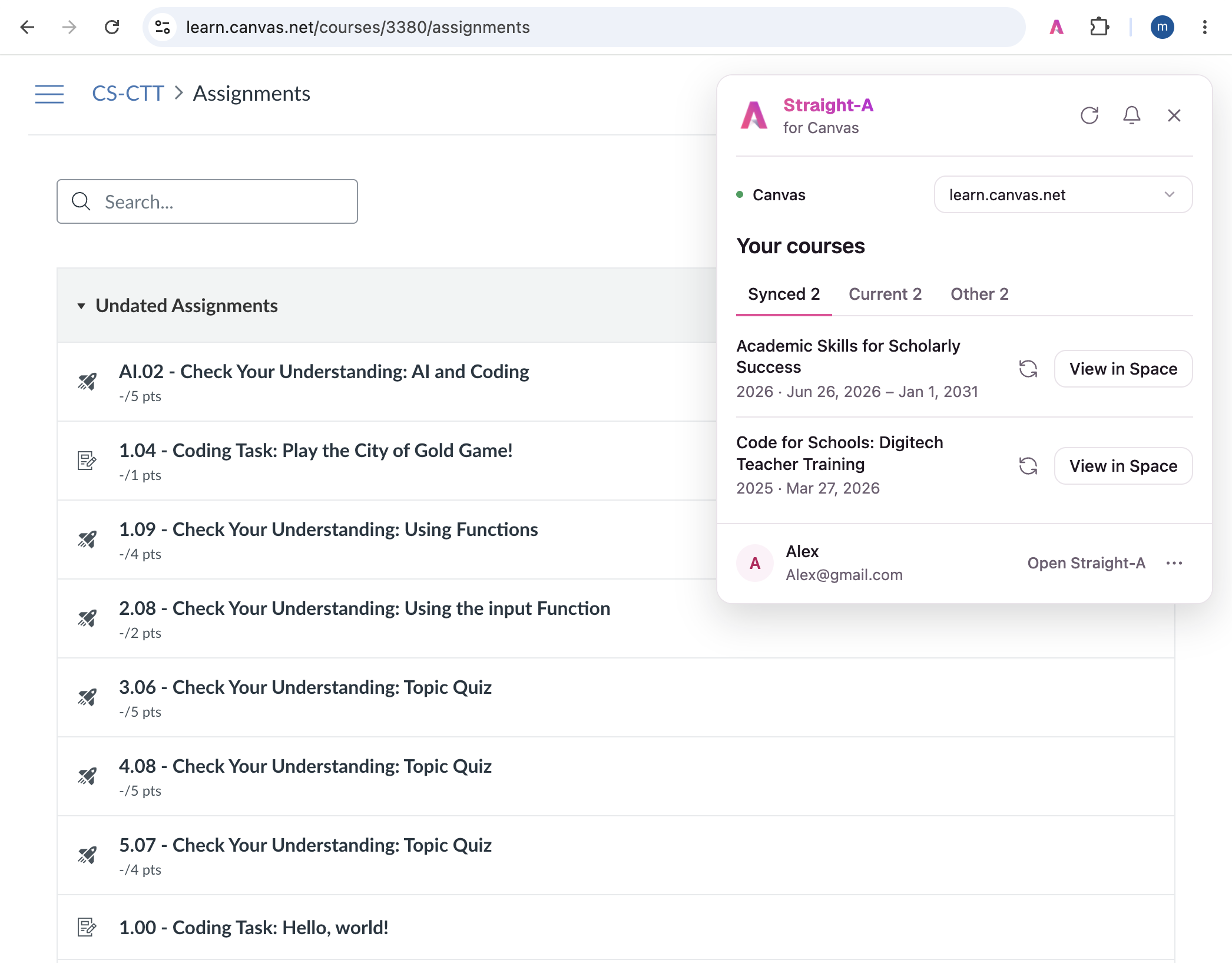
The extension detects the current Canvas course after you open it.
Assignments, discussions, files, syllabus content, attachments, and readable first-level links are collected in one run.
Everything is delivered as an organized course ZIP, with skipped or failed items reported clearly.
Who it's for
The brief is vague, the reading list is long, and the rubric is a PDF you haven't opened. Start there — it takes in all three before it asks you anything.
The reading outlives any single piece of writing. Keep it in one Space and each new chapter, review or response starts from everything you've read.
Straight talk
Worth saying plainly, because the category mostly doesn't.
Scope, angle and emphasis are the part that's actually yours. It will offer to decide, and it will tell you when it did — but the questions come to you first.
Every reference is resolved against the record. When something can't be verified, that's a flag on your screen, not a silent omission.
Every step is on the record: which file answered which question, which source produced which sentence. You can defend the draft because you can see how it was built.
Community
Drop in the brief. Within a minute you'll have the list of things it needs to know — which is more than the brief told you.
Stuck, or just curious? [email protected]